
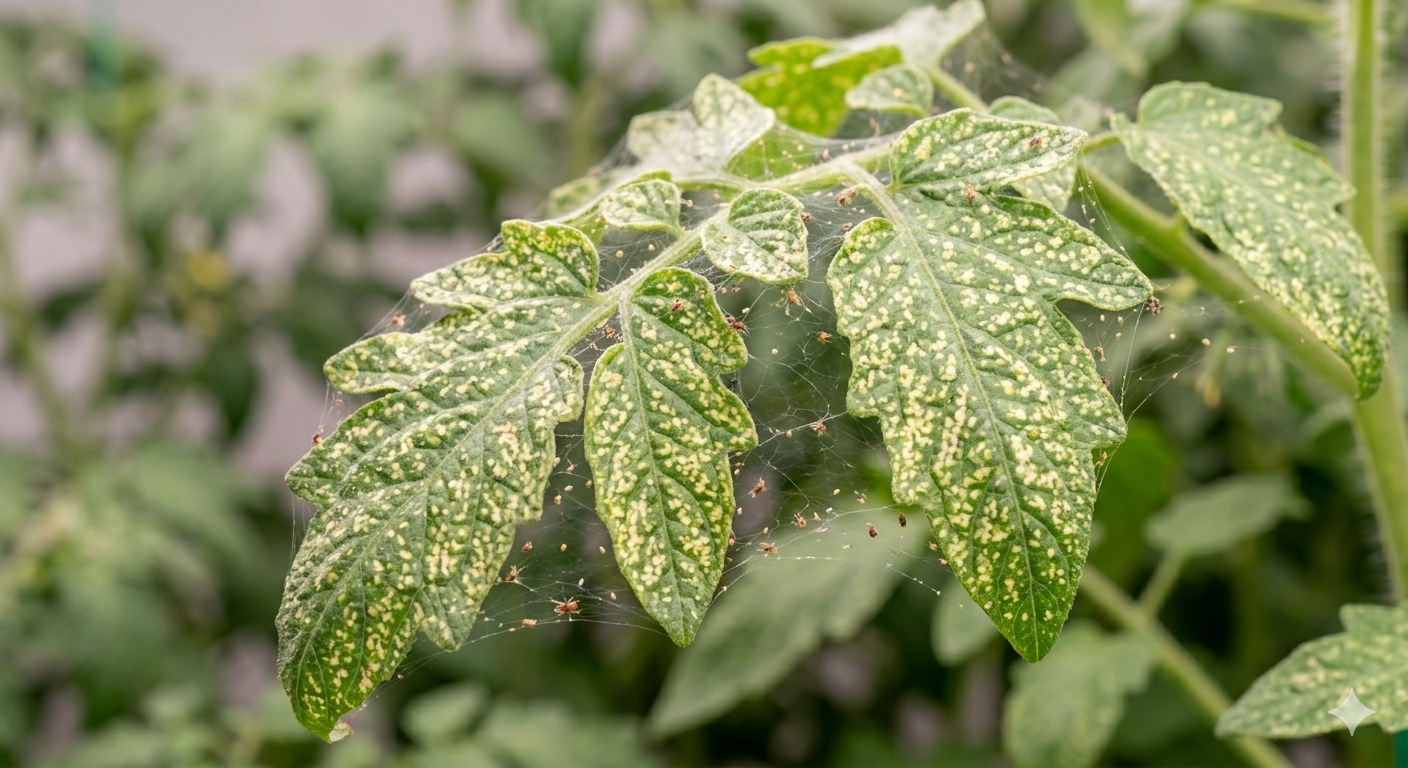
You can notice damage before seeing the pests; small yellow or white spots appear on leaves, signaling the need for spider mite treatment on plants. Up close, fine silk-like threads reveal colonies of tiny spider mites feeding.
Spider mites are tough pests: tiny, fast-reproducing, and thriving in warm, low-humidity conditions, making them hard to control with regular sprays.
To eliminate them effectively, you need more than surface treatment — a system like Eliminator by The Amazing Doctor Zymes breaks the entire pest cycle, not just the visible parts.
Why Spider Mites Are So Hard to Control
Spider mites are tiny, fast-reproducing pests that often go unnoticed until serious damage appears, making them extremely difficult to manage effectively.
They're Invisible Until the Damage Is Already Done
A spider mite is about half a millimeter long, which is smaller than the head of a pin. At that size, a colony of hundreds of mites can live on a single leaf for days before most growers notice something is wrong. The population has already grown too large for one treatment to fix by the time the characteristic leaf stippling (the tiny yellow or white dots caused by feeding damage) shows up.
One of the main reasons spider mite infestations spread so quickly is this gap in detection. Farmers don't catch them early because they really can't see them until they look under leaves with a hand lens.
Their Reproduction Rate Is the Real Problem

Spider mites have a very fast reproduction rate. A single female can lay up to 200 eggs in her lifetime when it's warm, like 27°C (80°F). The eggs can hatch in as little as three days. It takes five to seven days for the nymphs that come out to become sexually mature.
Because of this lifecycle, a small infestation can grow into a big one in just one week. It also means that any treatment that only works on adult mites will quickly fail when the next generation hatches. To be effective, control must include eggs, nymphs, and adults.
They Build Resistance to Chemical Pesticides
There is a lot of evidence that spider mites can become resistant to chemical miticides. Because their generations change so quickly, using spider mite spray cannabis carefully can help prevent resistance, and sometimes even in a single growing season. This is why farmers who use chemical treatments often have to switch between different products as each one stops working.
⚠ The key fact: The most important thing to know is that spider mites can't build up resistance to enzymatic disruption. Eliminator kills by breaking down exoskeletons and egg cases, not by being poisonous. There is no way to resist.
What Conventional Treatments Get Wrong
Most spider mite treatments that growers can buy, even those that are marketed as organic, only fix part of the problem and leave important gaps. Knowing about those gaps helps explain why infestations come back so often after treatment.
Neem Oil
Neem oil is one of the most common natural ways to get rid of spider mites. It works by messing with the insect's hormones and acting as a contact suffocant. It can work for light infestations that are treated early. The drawbacks become clear when the plants are big and in sensitive growth stages: it leaves an oily film on the leaves and flowers that doesn't evaporate, it can get into the plant tissue and change the quality of the fruit, and in hot weather, it can burn the leaves. Most growers won't accept neem oil residue on bud material during the flowering stage because it is a serious quality issue.
Insecticidal Soaps
Sprays that are made with soap work by getting through the outer membrane of soft-bodied mites and making them lose water quickly. Contact kill on adults is fine, but the formula leaves a residue on the surface, doesn't protect against hatching eggs, and can cause phytotoxicity, which is visible damage to leaf surfaces, especially with repeated use or in high temperatures. They also need to be sprayed very thoroughly to work, since mites can live in webbing or on the underside of plants with a lot of leaves.
Predatory Insects
Using predatory mites like Phytoseiulus persimilis is a good way to control pests naturally, especially in big greenhouses or outside. But in controlled indoor settings, predatory insect programs are hard to run, cost a lot to keep up with, and take a long time to set up—time that most growers don't have when an outbreak is going on. They are a way to stop problems in the long run, not right away.
The one thing that all of these methods have in common is that they don't always work for the egg stage. As long as the eggs survive treatment, the colony will come back on a regular basis. To completely get rid of spider mites, you need to break the cycle.
Eliminator vs. Spider Mites

The Amazing Doctor Zymes' Eliminator uses a food-grade enzyme system that works on the biological structures that spider mites need to grow at every stage of their life cycle.
Adult and Nymph Contact Kill
Even though spider mites are small, they have a well-defined exoskeleton structure that the enzyme formula in Eliminator goes after directly. The enzymes start to break down this protective outer layer as soon as they touch it, making it a safe spider mite chemical-free treatment. This works on both adult and nymph stages. Any mobile mite that the spray hits is taken care of right away.
Because the mechanism works with enzymes instead of chemicals, there is no chance of resistance developing. The same formula that works now will work the same way in three months, six months, and the next time you grow.
Egg Casing Breakdown
This is what makes the difference. Eliminator's enzyme system breaks down the protective protein shell around spider mite eggs, stopping the eggs from developing into a living nymph before they can hatch. Most organic and chemical treatments don’t get this part right, which is why choosing the best organic spray for spider mites matters.
By treating eggs along with the mite's mobile stages, a consistent Eliminator treatment schedule can break the reproductive cycle in two to three weeks instead of having to chase the population through several rebound cycles.
Webbing and Biofilm Disruption
Spider mite webs protect them and help them spread, making spider mite prevention greenhouse protocols essential. Eliminator's enzyme formula also breaks down the protein structures in webbing, which removes the protective environment that the colony lives in and makes it harder for them to spread to nearby plant surfaces.
Zero Residue — Harvest-Safe at Every Stage
Eliminator dries up completely after being used. There is no coating, oil film, or chemical trace left on the surfaces of leaves or flowers. This makes it perfect for use during the flowering stage, even in the last few days before harvest, without changing the quality, flavor, or smell of the product.
✔Approved by OMRI for use in organic farming. No time to re-enter. There is no buffer period for harvesting. At any stage of growth, it is safe to use on food crops, cannabis, herbs, and ornamental plants.
Spider Mite Treatment Steps
For active infestations, follow these steps. Once the infestation is completely gone, switch to the preventive schedule.
Step 1 — Assess and Isolate
Check how bad the infestation is before starting treatment. If you have a hand lens, look at the underside of the leaves on all of the plants. Find out which plants are currently infested and which ones are at risk because they are close to them.
- If you can, keep plants that are heavily infested away from the rest of the grow.
- Get rid of leaves that have a lot of webbing or stippling damage; don't compost them.
- Let more air into the growing area—spider mites like hot, still air.
Step 2 — First Treatment Application
- For active infestations, mix 25–30ml of Eliminator concentrate with 1 liter of clean water.
- Coverage: Use as a full foliar spray. The underside of the leaves is the most important part because that's where the mites, eggs, and webs are. Go through the canopy in a planned way, lifting leaves to make sure you cover everything.
- Stems and nodes: Don't just treat the surfaces of the leaves; treat all of the stem surfaces and node junctions. If you don't treat these areas, mites will hide there while you apply and come back after.
- Timing: To get the most contact time with the formula before it evaporates, use it when the lights are off inside or in the early morning or evening outside.
Step 3 — Repeat Treatment Cycle
- How often: For the first three weeks, treat every three days. This schedule is based on the life cycle of spider mite eggs. Treating every three days makes sure that newly hatched nymphs are taken care of before they are old enough to reproduce.
- Don't forget to apply: If you miss a treatment in this cycle, the population can stabilize and bounce back. The most important thing for full resolution is consistency.
- Use sticky traps to keep an eye on things: Put white sticky traps at the level of the canopy. After the first week of treatment, you should be able to see that mite activity on the traps has gone down. If it doesn't, raise the mix ratio to 30ml per liter.
Step 4 — Transition to Prevention
- Ratio of mix: 15ml of Eliminator concentrate for every liter for long-term protection.
- How often: Once a week after the problem has been fixed. Go on with the rest of the growth cycle.
- Environmental upkeep: Make sure the relative humidity stays between 50 and 60 percent and that the air flow stays steady. These conditions make it hard for mites to reproduce, which greatly lowers the risk of reinfestation.
- Soil application: Use Eliminator as a root drench (15ml per liter) every two weeks to help the plants' immune systems and the biology of the soil.

Frequently Asked Questions
Can Eliminator be used during the flowering stage without affecting quality?
Yes. Eliminator is water-based and dries completely after use, so there is no residue left on the flowers. There is no need for a harvest buffer or a re-entry interval. Growers can use it all the way through the flowering stage, even in the last few days before harvest, without it affecting the taste, smell, or quality of the product. This is one of the most important practical benefits it has over neem oil and other options that leave behind residue.
How long does it take to fully eliminate a spider mite infestation?
Most growers notice a clear and lasting drop in spider mite activity within 10 to 14 days of using it every three days. After starting the treatment plan, the problem usually goes away completely, including the eggs and nymphs, within three weeks. The important thing is to not miss any applications during this time. The 3-day cycle is set up to break up the timeline from egg hatching to reproduction.
Why do spider mite infestations come back after treatment with other products?
Most of the time, rebound infestations are caused by eggs that survived. Most organic and chemical treatments kill adult and nymph mites that can move around, but they don't work well on the egg stage. The population grows quickly again after the eggs hatch 3 to 5 days after treatment. Eliminator solves this problem by breaking down egg casings with enzymes and killing mobile stages on contact. This is why it works better and lasts longer than treatments that only work on the surface.
Is Eliminator safe to use in organic certified growing operations?
Yes, Eliminator is OMRI listed, which means that it has been looked at and approved for use in organic farming. All of its ingredients come from plants, are safe to eat, and break down naturally. There are no synthetic chemicals, restricted substances, or compounds that would change the status of organic certification.
Act Fast Against Spider Mites
In three days, a small colony can turn into a big problem. That's the time frame that spider mites use. Your treatment needs to work faster and cover the whole cycle, not just what's visible on the surface right now.
Eliminator's enzyme formula kills on contact, breaks down eggs before they hatch, and doesn't leave anything on your plants. No leftovers. No risk of resistance. Don't settle for less than the best quality in what you're growing.


Leave a comment
This site is protected by hCaptcha and the hCaptcha Privacy Policy and Terms of Service apply.