
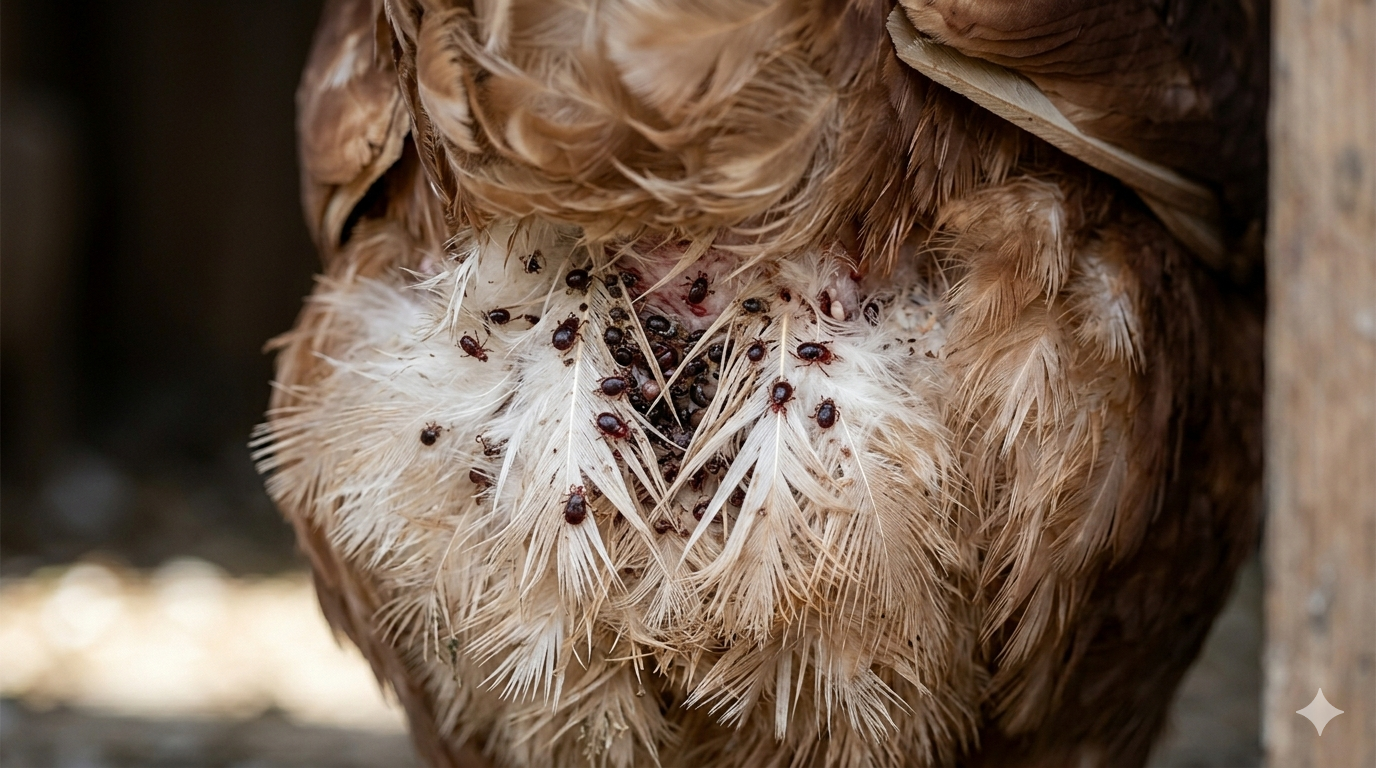
It looks like your hens are bored. There are fewer eggs being made. A bird that used to lay eggs every day is now missing days. You look in the coop at night with a flashlight and run your finger along the roost bars to find them. Little dots that move quickly and scatter when the light hits them. Mites.
Poultry mites are one of the worst and most annoying problems that a flock keeper can have. They are active at night, hide in the coop during the day, breed in huge numbers, and the most common treatments—chemical dusts and synthetic pesticide sprays—either put your birds and eggs at risk or don't fix the whole problem.
This guide explains how mites work and provides a comprehensive look at how to get rid of mites on chickens using Poultry Guard by The Amazing Doctor Zymes, a complete enzyme-based solution that is safe for your birds and eggs and works at all stages of the mite life cycle.
Know Your Enemy:
Not all poultry mites act the same way, and knowing the difference is important for figuring out how to treat them.
Red Mite (Dermanyssus gallinae)
Red mites are probably the most common pest for birds all over the world. They are parasites that feed on blood and mostly live in the coop, not on the birds themselves. During the day, they stay out of sight in cracks, crevices, the ends of roosts, the corners of nest boxes, and any other dark space in the structure. They come out at night to eat birds that are roosting, then go back to sleep before dawn.
This is why red mites are so hard to find and so hard to get rid of. You can look closely at your birds and not find anything because the mites aren't on them during the day. When you see them on birds during the day, the infestation is already very bad.
The effect on the flock builds up over time:
- Anemia is caused by long-term blood loss, which shows up as pale combs and wattles, tiredness, and less activity.
- Stress from feeding every night messes up sleep patterns, which directly lowers egg production.
- Severe infestations can kill young birds or hens that are already weak.
- Feather damage, scratching, and changes in behavior, such as not wanting to go into the coop, are all caused by constant irritation.

Northern Fowl Mite (Ornithonyssus sylviarum)
Northern fowl mites have a different plan by staying on the host for good, which is why a northern fowl mite organic treatment must be applied directly to the bird’s feathers. They don't go back to the coop between feedings like red mites do; instead, they live their whole lives on the host. This makes them easy to see during feather inspections, especially around the vent area, under the wings, and along the back.
Birds can quickly spread northern fowl mites to each other by touching them directly. They make:
- Heavy feather soiling and matting around the vent is a clear sign of an active infestation.
- Skin irritation and scabbing from constant eating
- A lot of weight loss and less efficient feed conversion
- In flocks with a lot of parasites, egg production can drop by as much as 15–20%.
Key insight: You need to treat the coop first and then the birds for red mites. As a first step, northern fowl mites need to be treated directly on birds. Poultry Guard takes care of both of these things: it is used on birds and in the coop as part of a full Eco-Biosecurity protocol.
Why Standard Mite Treatments Keep Failing
Most flock keepers have gone through the same frustrating cycle: things get better for a few days, but the mites return with a vengeance. This is because conventional methods often fail to address the root of the problem while introducing new risks to your birds.

Chemical Dusts and Synthetic Pesticide Sprays
The most common treatments use synthetic chemicals like permethrin to attack the mite’s nervous system. While they provide an immediate "knock-down," the downsides are significant. These chemicals can leave toxic residues in bird tissue and, more importantly, in the eggs you eat. Many of these products require a "withdrawal period" where you must throw away eggs for weeks. Furthermore, mites quickly build a genetic resistance to these chemicals, making them less effective over time. Poultry Guard offers a zero-residue, resistance-free alternative that allows you to eat your eggs the same day you treat your birds.
Diatomaceous Earth
While chemical-free, DE works as a physical abrasive that dehydrates mites. However, its effectiveness is highly limited. It only works in bone-dry conditions; any moisture in the coop makes it useless. More importantly, breathing in fine DE particles is a serious health risk, causing respiratory irritation for both birds and keepers. Unlike DE, Poultry Guard remains effective in humid or wet conditions and poses no respiratory threat to your flock.
Essential Oil Sprays
Natural repellents made with tea tree or peppermint oils often act only as a temporary deterrent. Instead of killing the infestation, they simply cause the mites to move to a different part of the coop. They also require constant re-application and can overwhelm a bird’s sensitive respiratory system. Poultry Guard goes beyond "repelling"—its enzymatic action physically breaks down the mite’s structure and egg casings to end the infestation for good.
How Poultry Guard Breaks the Mite Cycle

The Amazing Doctor Zymes' Poultry Guard is a 100% natural, enzyme-based insecticide and fungicide made just for use in poultry environments. It doesn't work by making things toxic like chemical treatments do. It doesn't need dry conditions like physical abrasives do. It has a precise enzyme system that breaks down the biological structures that mites need to live at every stage of their life cycle.
Contact Kill on Adult and Nymph Mites
As soon as the Poultry Guard solution touches a mite, whether it's on a bird's skin, in feather shafts, or on the coop's surface, the enzymes start to break down the mite's exoskeleton. This physical breakdown process works quickly and well on all stages of mobile life, even nymphs that have just hatched and are not yet able to reproduce.
Mite populations can't build up resistance to it because the mechanism is enzymatic instead of chemical. The same formula works just as well in month six as it does in week one. There is no need to change it or make it stronger.
Egg Casing Breakdown — the Key Differentiator
This is what makes Poultry Guard different from almost all other treatments on the market. The enzyme formula breaks down the protein shell around mite eggs, which stops their growth before they can hatch. Both red mite eggs in the coop's cracks and northern fowl mite eggs attached to feather shafts are dealt with.
This egg-stage action is what makes a consistent Poultry Guard treatment plan work for a long time, not just for a short time. When you break the reproductive cycle instead of just lowering the number of adults, the infestation doesn't come back on the same schedule every time.
Safe for Birds, Safe for Eggs
All of the ingredients in Poultry Guard come from plants, are safe to eat, and break down naturally. This is not just a marketing phrase; it is a fact that makes this mite treatment laying hens safe for keepers who want to eat their eggs without a withdrawal period:
- No withdrawal period for eggs: hens can keep laying eggs, and the eggs are safe to eat during treatment.
- After use, there are no chemical residues left on feathers, skin, or eggs.
- There is no waiting period; birds can go back to a treated coop right away.
- Safe for chicks, broilers, layers, and hens that are brooding
- OMRI listed—allowed to be used in certified organic poultry farms
✔ Poultry Guard is one of the few poultry mite treatments that works on both eggs and nymphs, is safe for hens that are laying eggs, and is approved for use in certified organic farms.
Step-by-Step Mite Treatment Protocol

To get rid of mites, you need to treat both the birds and the area around them. If you treat one without the other, the problem will come back in a few days. This plan includes both.
Step 1 — Inspect and Identify
Before you start any treatment, make sure you know what kind of infestation you're dealing with and how bad it is.
- Red mite check: Check for red mites by looking around the coop at night with a flashlight. Use a white cloth or your finger to wipe down the roost bars, the corners of the nest box, and any cracks or crevices. Red mites look like tiny dark or reddish dots that move when you touch them. When there are a lot of them, you might see groups of hundreds.
- Northern fowl mite check: To check for northern fowl mites, pull back the feathers around the vent, under the wings, and along the back of each bird. Look for dark stains on the shafts of feathers, mites that are easy to see moving around, and skin that is red or scabby.
- Record severity: Keep track of which birds seem to be the worst off, the overall health of the flock (comb color, activity level, egg production), and the parts of the coop where there are the most mites. This helps you keep track of how well the treatment is working.
Step 2 — Coop Treatment (Critical for Red Mites)
- Mix ratio: For active infestations, mix 30ml of Poultry Guard concentrate with 1 liter of clean water.
- Remove birds first: Before treatment, move the hens out of the coop so that all surfaces can be reached easily.
- Coverage: Use the Poultry Guard solution on all surfaces inside the coop, including the roost bars, the insides and cracks of the nest box, the joints between the walls, the edges of the floor, and any visible crack or gap where mites can hide. Use a pump sprayer or spray bottle to make sure the solution gets into tight spaces.
- Bedding: Before treatment, take off and replace all bedding. No matter how you treat the surface, mite eggs in old bedding will hatch. Before putting down new bedding, clean the bare floor.
- Frequency: For the first three weeks of an active infestation, treat the coop every three to four days. This rhythm covers the red mite egg hatch cycle and stops eggs that survive from hatching.
Step 3 — Direct Bird Treatment (Both Mite Types)
- Mix ratio: To use directly on birds, mix 20–25ml of Poultry Guard concentrate with 1 liter of water.
- Application method: Spray or mist it on, and make sure to separate the feathers so that the skin is covered. Pay close attention to the vent area, under the wings, along the back, and around the neck. These are the places where mites are most likely to be.
- Eyes and nostrils: Don't touch your eyes or nostrils directly. If you need to, spray it on a gloved hand and work it into the feathers around the head.
- Frequency: During the active treatment phase, give birds a dose every 3 to 4 days. After the infestation is over, switch to a weekly preventive treatment.
- Stress reduction: Be calm when you treat the birds. Do your work in the early morning or late evening when birds are more relaxed.
Step 4 — Environmental Maintenance and Prevention
- Ongoing coop treatment: Once the active infestation is gone, treat the coop once a week with the usual amount of water (15ml per liter).Red mites can come back into the house with wild birds, new flock members, or tools. Using the solution as a weekly chicken coop mite prevention spray makes it hard for new colonies to settle in and multiply.
- New bird quarantine: Give the new bird Poultry Guard before letting it join the flock.Northern fowl mites, in particular, spread quickly from a new addition that is already infested.
- Ammonia control: When used as a litter spray or drench, Poultry Guard also kills the bacteria responsible for a pungent ammonia smell chicken coop environments often struggle with. Ammonia stress makes the damage that mites do worse. Taking care of both at the same time helps the flock recover faster.
- Monitor production: Keep an eye on egg production every week. If production levels go back to normal within 3–4 weeks of starting treatment, that is a good sign that the mite pressure is under control.
How to Know the Treatment Is Working
Mite infestations don't go away overnight, but you should see some improvement within the first week of regular treatment. Here's what you should look for:
Week 1
- During a nighttime check, there were fewer mites on the roost bars.
- At roosting time, birds seem less upset.
- Feather soiling around the vent area starts to go down in cases of northern fowl mite.
Week 2
- The color of the comb and wattle is starting to return to normal in birds with anemia.
- Birds are more active and aware during the day; their activity levels are rising.
- Egg production is starting to get better, but it will take longer for it to fully recover.
Week 3 and Beyond
- Few or no mites found during coop inspections
- The condition of the feathers is getting better as new growth replaces broken shafts.
- Egg production is getting back to where it was before the infestation.
- Normal flock behavior—birds willingly going back to the coop at dusk
Frequently Asked Questions
Is Poultry Guard safe to use on laying hens without affecting egg safety?
Yes. Poultry Guard's enzyme formula comes from plants, is safe for food, and doesn't leave any chemicals on feathers, skin, or eggs. There is no withdrawal period; hens can keep laying eggs, and the eggs are safe to eat during the whole treatment period. This is one of the best things about this method over chemical treatments, which usually require eggs to be taken out for several weeks.
Can I use Poultry Guard in the coop while birds are present?
It is best to move the birds out of the coop first so that all surfaces, especially crevices and roost bars, can be fully sprayed. You can use Poultry Guard on birds that are already there for direct bird treatment. There is no waiting period for birds to return to a treated coop; they can do so as soon as the application is done and the surfaces are no longer wet.
How does Poultry Guard compare to diatomaceous earth for poultry mites?
Diatomaceous earth works by physically scraping off the outer layer of the mite's body. It needs to be dry to work. It doesn't work on eggs, needs to be reapplied all the time, and breathing it in repeatedly can be bad for both birds and their keepers. Poultry Guard works by disrupting enzymes in all stages of mite life, including eggs. It stays effective no matter how humid it is, doesn't need any respiratory precautions, and is safe to use directly on birds and their surroundings without any concerns about withdrawal.
How long before I see egg production recover after treating mites?
Most flock owners notice that their birds start to produce more eggs within two to three weeks of starting a regular treatment plan. This is because the number of mites goes down and the birds have less stress and blood loss at night. It usually takes four to six weeks for the flock to fully recover to pre-infestation production levels. This depends on how long the infestation was present and how healthy the flock was before treatment started.
Can Poultry Guard be used as a preventive treatment before mites appear?
Yes, and this is the best way to use it. A weekly application of Poultry Guard to the coop surfaces and a monthly direct bird treatment keep the environment from letting mite populations grow and spread. Growers who follow a preventive Eco-Biosecurity schedule consistently report fewer and less severe infestations than those who only treat them when they happen.
Your Flock Deserves Protection That Works
Mites are a problem that can be dealt with, but only if you know how. Chemical treatments that leave behind chemicals in your eggs, dustings that don't get into the cracks where mites hide, and quick-fix sprays that don't touch the egg stage will keep you in a cycle of infestations.
Poultry Guard stops that cycle by acting as a safe mite spray chickens no chemicals can compete with for long-term effectiveness. Enzymes that work on adults and nymphs by touch. Breakdown of the egg casing that messes up the reproductive cycle. No chemicals left on your birds or their eggs. Safe for organic farms. Safe for your flock from the start.


Leave a comment
This site is protected by hCaptcha and the hCaptcha Privacy Policy and Terms of Service apply.