
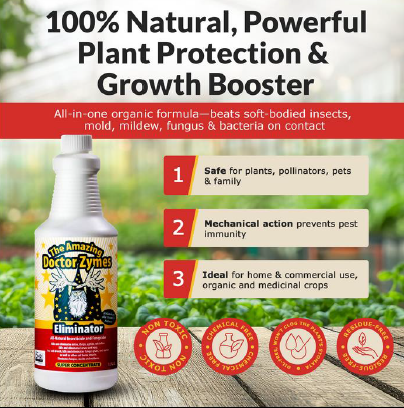
Direct answer: In late flower, most miticides are off the table — oils and soaps clog stomata and can damage trichomes, and anything that leaves residue is a harvest risk. Doctor Zymes Eliminator is a citric-acid enzyme with no oil and no residual, so you can spray it into late flower. It kills on contact through a mechanical mode of action, which is why russet mites can't build resistance to it. Cover thoroughly and re-treat on a cycle to stay ahead of new hatches on the plant — and a soil drench at 1 cup per 5 gallons kills eggs and larvae in the growing media to break the cycle at the root zone.
How to know it's russet mites
Russet mites are near-microscopic — you need a 60x loupe or a scope to see them. By the time damage is visible, the population is established. Look for:
- Bronzing or a glossy, wet-looking sheen on stems and leaf undersides, especially up near the newest growth.
- Curled, “tacoed,” or downward-cupping leaves — russets concentrate in the tightest new growth and inside those curls.
- Stunted, twisted new growth at the tops while lower growth still looks normal.
- A plant that keeps declining after you've treated for spider mites and seen no webbing — russets don't web.
Why late flower is the hard part
Most of what growers reach for is disqualified exactly when russets tend to flare:
- Oils and soaps clog stomata. They coat the leaf, and in flower that means reduced gas exchange and damaged trichomes right where it matters.
- Residue is a harvest problem. Anything that lingers on the flower is a smell, taste, and residue-test risk.
- Repeated chemistries invite resistance. Miticides with a chemical mode of action lose potency against a population that adapts.
Eliminator sidesteps all three. It's oil-free, so there's nothing to clog stomata. It's contact-kill with no residual, so nothing is left on the flower. And its mode of action is mechanical — it disrupts respiration and denatures proteins across egg, larva, and adult — so there's nothing for a russet population to build resistance against.
Treatment protocol
Eliminator is OMRI Listed and mixes with water. Use the rate that matches the job, and follow the registered label.
| Situation | Eliminator rate | Frequency |
|---|---|---|
| Preventive / maintenance | 2 oz per gallon | Weekly |
| Active infestation (knockdown) | 4 oz per gallon | 3–5 consecutive days, then weekly |
| Soil / media (kills eggs & larvae) | 1 cup per 5 gallons | As a drench |
Mix with warm water — it raises efficacy — and spray lights-out (after dark) and under 80°F. If plants are outdoors, rinse before direct sun.
Coverage and the re-treatment cycle
This is where russet treatments succeed or fail.
- Cover everything. Top and underside of every leaf, stems, stalks, and the base. For russets, get the spray inside the tacoed and curled leaves where they hide — a light pass over the canopy misses them.
- Stay ahead of the hatch. Run the knockdown on consecutive days, then weekly, so your coverage keeps catching mites as new ones emerge on the plant.
- Kill eggs and larvae at the source. A soil drench at 1 cup per 5 gallons kills eggs and larvae in the soil and growing media — closing the reproductive cycle that a foliar spray alone can leave open.
- Remember the foliar spray is contact-kill with no residual. That's the trade for a clean, residue-free harvest — it works where it lands, so thorough application beats a quick pass every time.
What not to do
- Don't spray with the lights on or over 80°F. That's where burn comes from — not the product.
- Don't reach for oils or soaps in late flower. The stomata clogging and trichome damage aren't worth it this close to harvest.
- Don't do one pass and call it done. A single spray without the cycle — and without a drench — leaves the next generation untouched.
- Don't spray the canopy top only. Russets live in the tight new growth and leaf curls; open them up.
Frequently asked questions
Can I really spray Eliminator in late flower?
Yes. It's oil-free and leaves no residual, which is why it stays usable when oils and soaps are off the table. Follow the label rate and the lights-out / under-80°F guidance, and rinse before sun if you're outdoors.
Will russet mites become resistant to it?
No. The mode of action is mechanical — it disrupts respiration and denatures proteins rather than acting on a chemical pathway — so there's nothing for the population to adapt to.
How often do I re-treat?
Knockdown is 4 oz/gal for 3–5 consecutive days, then weekly at the preventive rate, so your coverage keeps catching mites as new ones hatch on the plant. Pair the foliar spray with a soil drench at 1 cup per 5 gallons to kill eggs and larvae in the growing media and break the cycle at its source.
Why did bugs die on a leaf I cut but survive on the plant?
Coverage. The foliar spray is contact-kill with no residual, so anything you didn't reach is unaffected. Hit the undersides, the stems, the base, and inside the curled leaves.
Does it leave a taste or smell on the flower?
No residual is the point — there's nothing left to mask, taste, or fail a residue panel, which is exactly why it fits this stage.
Bottom line
Russet mites in late flower are hard because the stage disqualifies most of your options — not because they're unbeatable. An oil-free, residue-free, mechanical-action miticide lets you treat right up to harvest without clogging stomata or risking your flower — as long as you cover thoroughly, hold the re-treatment cycle, and drench the media at 1 cup per 5 gallons to reach the eggs and larvae.


Leave a comment
This site is protected by hCaptcha and the hCaptcha Privacy Policy and Terms of Service apply.